
• Diamond Home page
  • About
  • For Users
  • Public
  • Industry
  • Instruments
  • Careers
  • More Show more menu items
Search

About

  • About Diamond
  • About Synchrotrons
  • News and Features
  • Events
  • Contact Us
  • FAQ

For Users

  • Apply for beamtime
  • User guide
  • Diamond Users Commitee
  • FAQ
  • User Administration System
  • iSpyB

Industry

  • Techniques Available
  • Industry Research
  • Industry Case Studies
  • News
  • Meet the Industry Team

Science

  • Research
  • Computing
  • The Machine
  • Publications
  • Research Expertise
  • Membrane Protein Laboratory
  • Additional Facilities
  • Publications Database

Instruments

  • Biological Cryo-Imaging
  • Crystallography
  • Imaging and Microscopy
  • Macromolecular Crystallography
  • Magnetic Materials
  • Soft Condensed Matter
  • Spectroscopy
  • Structures and Surfaces

Diamond-II

  • Science
  • Machine
  • Beamlines
  • Software, Control and Computing
  • Infrastructure

Public

  • Public open days
  • School visits
  • Partner with Diamond
  • Explore Diamond

Procurement

  • Non-OJEU Tender Notices
  • OJEU PINs
  • OJEU Tender Notices
  • Registration Form

Careers

  • Vacancies
  • Info for applicants
  • Company Benefits
  • Apprenticeships
  • PhD Studentships
  • Work Placement

Main Content

A brighter light for science
Sub-navigation
  • About
  • Governance
  • Legal and Compliance
  • News and Literature
  • Events
  • Contact

In This Section

Sub Navigation
  • News and Science Highlights
  • Annual Review
  • Literature Reviews
  • Impact Case Studies
  • Press and media

Opportunities at Diamond

Learn more about career and student opportunities at Diamond:

Vacancies

Students

  1. Diamond Light Source
  2. News and Literature
  3. Annual Review
  4. Diamond Annual Review 2018
  5. Science Group Updates
  6. Magnetic Materials Group

Magnetic Materials Group

  • annual review
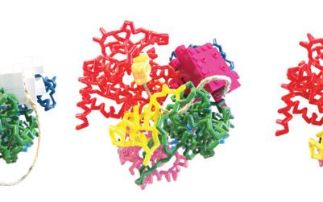
    Sweet Success: Crystal structure of the full-length GLP-1 receptor bound to a peptide agonist

    Sweet Success: Crystal structure of the full-length GLP-1 receptor bound to a peptide agonist Jun 1, 2018

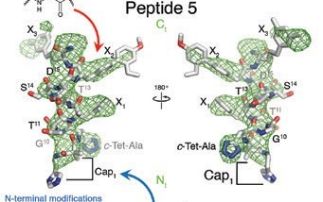
    To design such small molecules, a detailed map of the interactions between GLP-1 and its receptor was needed.

  • annual review
    Structural insights into the mechanism of bacterial ABC transporters

    Structural insights into the mechanism of bacterial ABC transporters Jun 1, 2018

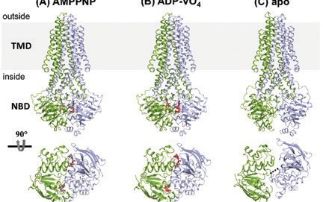
    Bacteria utilise ATP-binding cassette (ABC) transporters to import nutrients and detoxify themselves. These transporters have been shown to exist in wide open conformations that permit the access of many substrates in the binding pocket.

  • annual review
    Structure of the surface layer surrounding Caulobacter crescentus bacteria

    Structure of the surface layer surrounding Caulobacter crescentus bacteria Jun 1, 2018

    Many types of single-celled microorganisms such as bacteria are covered with a protective outer layer of proteins known as the S-layer.

  • annual review
    How does an inspector call: structures of UGGT, the eukaryotic glycoprotein quality control checkpoint.

    How does an inspector call: structures of UGGT, the eukaryotic glycoprotein quality control checkpoint. Jun 1, 2018

    In all cells derived from animals, plants, fungi and protozoa a single protein called UGGT acts as a quality control checkpoint that inspects secreted glycoproteins.

  • annual review
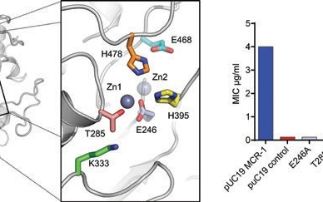
    Insights into the mechanism of colistin resistance from crystal structures of MCR-1

    Insights into the mechanism of colistin resistance from crystal structures of MCR-1 Jun 1, 2018

    Gram-negative bacteria that are extensively resistant to multiple antibiotics are an ever-increasing global threat. Colistin is an antibiotic used as the last line of defence against highly resistant Gram-negative bacteria. However, in recent years bacteria have emerged with resistance to this crucial antibiotic.

  • annual review
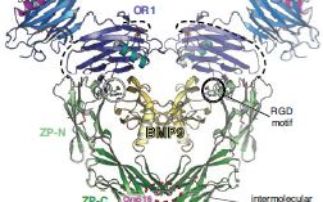
    How human endoglin captures its ligand BMP9

    How human endoglin captures its ligand BMP9 Jun 1, 2018

    Endoglin (ENG)/CD105 is a mammalian glycoprotein that is found in the membranes of cells that line blood vessels. It is essential for healthy heart development and blood vessel growth, but conversely it is also involved in preeclampsia and can help tumours establish their blood supply.

Sarnjeet Dhesi, Science Group Leader

Update

The newly formed Magnetic Materials Group concentrates on emergent phenomena in quantum materials using the capabilities of beamlines I06, I10, I16, B16 and I21. The research encompasses a variety of challenges and opportunities at the frontiers of condensed matter physics and materials science ranging from topological states of matter, superconductivity, spintronics, two-dimensional systems, skyrmions and multiferroics. The key insights made by researchers exploit the high sensitivity of polarised X-ray spectroscopy, microscopy and scattering available across the beamlines. Read more ...
  • annual review
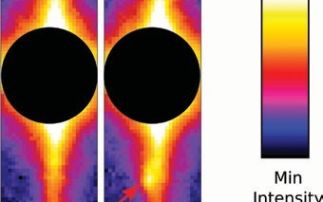
    Fast Active Optics for Synchrotron Radiation

    Fast Active Optics for Synchrotron Radiation Jun 1, 2018

    Synchrotron light sources produce a strong and stable pulsed beam, for which the pulse sequence is dependent on the circumference of the storage ring. Many experiments only require some of the pulses, including ‘pump and probe’ experiments that activate a process and then measure it.

  • annual review
    Adding electrons to switch magnetic chirality

    Adding electrons to switch magnetic chirality Jun 1, 2018

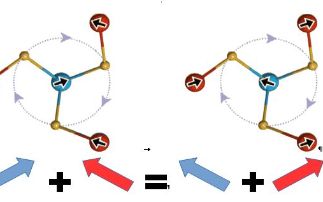
    The Dzyloshinskii-Moriya interaction (DMI) was first introduced in 1957 to explain ‘weak ferromagnetism’.

  • annual review
    Engineering platinum resistivity to enhance spin-orbit torque

    Engineering platinum resistivity to enhance spin-orbit torque Jun 1, 2018

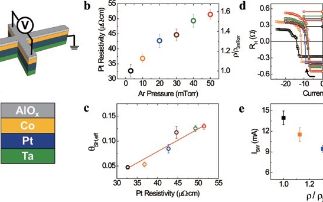
    Spin-orbit torque (SOT) arises from spin-orbit coupling in heavy metal/ferromagnet bilayers, and can be used to control the magnetisation direction. It is of considerable interest as a way to efficiently switch the magnetisation of spintronic devices, which have advantages over traditional electronic devices, including non-volatile memory and logic applications. In order to engineer materials with enhanced SOT, for lower power consumption, scientists are investigating the microscopic origin ...

  • annual review
    Imaging exchange coupling in multiferroic, multifunctional devices

    Imaging exchange coupling in multiferroic, multifunctional devices Jun 1, 2018

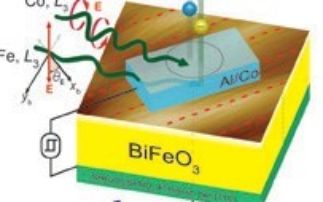
    The data storage on which out smartphones, tablets and computers rely works via electrical fields (e.g. flash drives) or magnetic fields (e.g. hard drives), but research into magnetoelectric materials could lead to a new generation of multifunctional devices that use a combination of the two.

  • Contact Us
  • About Diamond Light Source
  • Procurement
  • Supply Chain Transparency
  • Cookie Policy
  • Website Terms of Use
  • Privacy Notice

Diamond Light Source

Diamond Light Source is the UK's national synchrotron science facility, located at the Harwell Science and Innovation Campus in Oxfordshire.

Follow us on Facebook Follow us on Linkedin Follow us on Instagram Follow us on Bluesky

Diamond Light Source Ltd
Diamond House
Harwell Science & Innovation Campus
Didcot
Oxfordshire
OX11 0DE

See on Google Maps

Copyright © Diamond Light Source. Diamond Light Source® and the Diamond logo are registered trademarks of Diamond Light Source Ltd

Registered in England and Wales at Diamond House, Harwell Science and Innovation Campus, Didcot, Oxfordshire, OX11 0DE, United Kingdom. Company number: 4375679. VAT number: 287 461 957. Economic Operators Registration and Identification (EORI) number: GB287461957003.

feedback