New vacuum assembly marks latest Diamond-II milestone
Jul 2, 2026
Jul 2, 2026
Since the Diamond Extension Building (DEB) became operational earlier this year, the new facility has enabled a series of important milestones for the upgrade project. The D-II pre-series girders, which form the structural backbone of the machine and support a wide range of components, arrived in January. With all the DEB facilities up and running, including the high specification clean room, the vacuum team have successfully assembled pre-series vacuum vessels and associated components into three complete vacuum strings. In total, four pre-series vacuum strings will be built and installed onto the pre-series girders and ultimately used as spares for the upgraded machine. This milestone has depended on coordinated work across the Vacuum, Engineering, Survey Alignment and Procurement teams to bring together the components, infrastructure and processes needed for assembly.
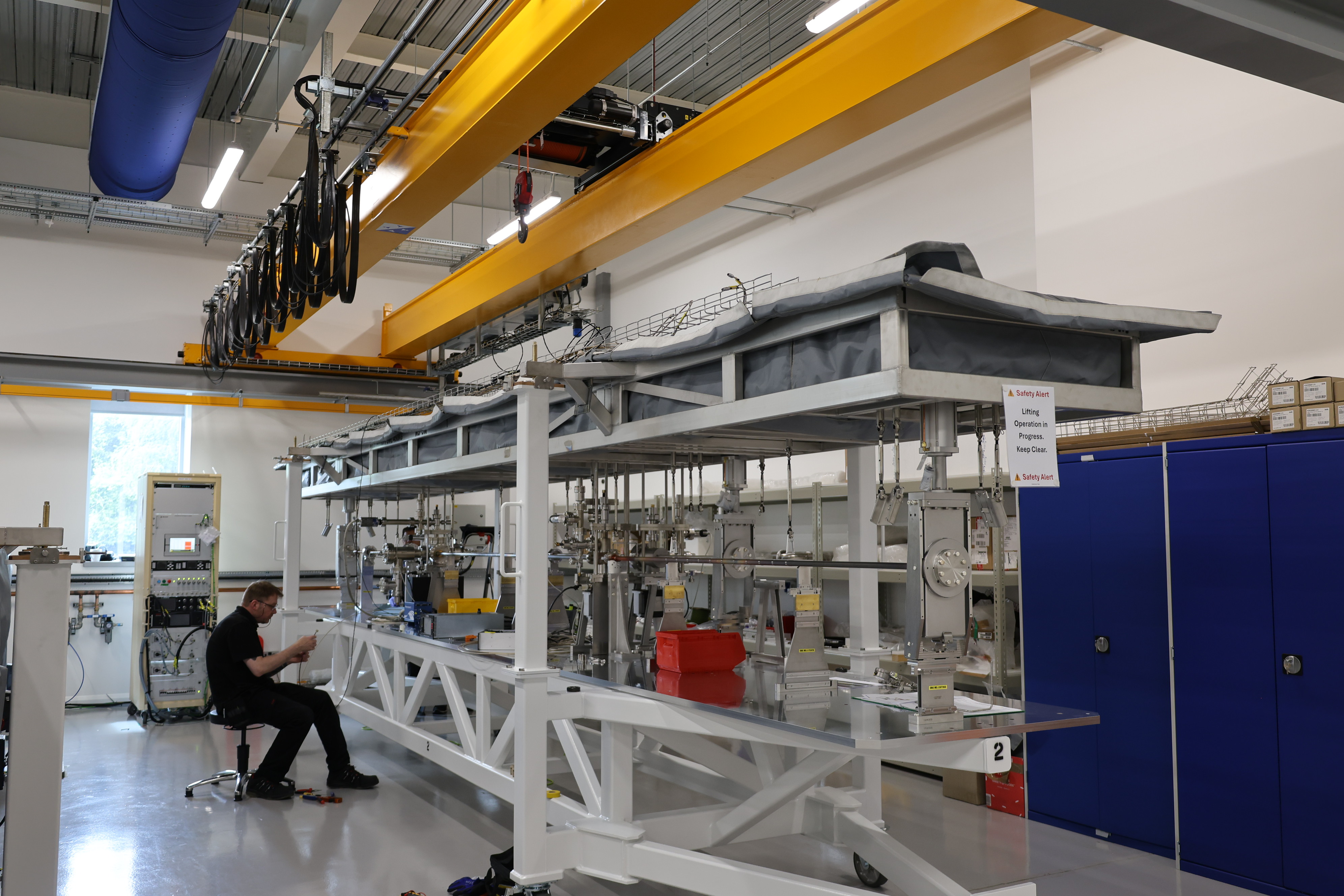
A vacuum is essential in a synchrotron because it provides the ultra-high vacuum (UHV) environment required for electrons to travel without interruption. In the storage ring, electrons travel at close to the speed of light, and even low levels of residual gas can cause interactions that scatter the electrons and lead to reduced beam lifetime and affect stability. For users, this has direct consequences such as fluctuations in beam intensity, interruptions during experiments, and reduced data quality. Maintaining a stable UHV environment is therefore critical to ensure the beamlines can deliver consistent performance and precision measurements for users over extended experimental runs.
For the Diamond‑II upgrade, the importance of vacuum is even greater due to the move towards a lower emittance, higher brightness beam, which is inherently more sensitive to disturbances. Along with many of the technical components of the new machine, this has required a fundamental rethink of the design of the vacuum system.
In the current machine, the beam travels through relatively large vacuum chambers, typically around 80 mm wide by 40 mm high, supported by pumps positioned at intervals along the ring. This has worked effectively, but the upgraded Diamond-II design requires a much more compact arrangement owing to the dense layout of magnets required to achieve the brighter light. The new vacuum chambers will be significantly smaller, measuring around 20 mm internal diameter to accommodate this challenge.
The lack of space in the new design has also had an impact on the usage of pumps. Instead of relying on a series of large external pumps, as in the current machine, a more integrated approach will be taken to use vacuum pipes coated with NEG (Non-Evaporable Getter), supported by fewer small ion pumps in key locations. The NEG coating is a very thin layer of reactive metal alloy that is activated by heat and works by chemically capturing the gas that it encounters. The NEG coating transforms the beam pipe from a passive surface into an active part of the pumping process.
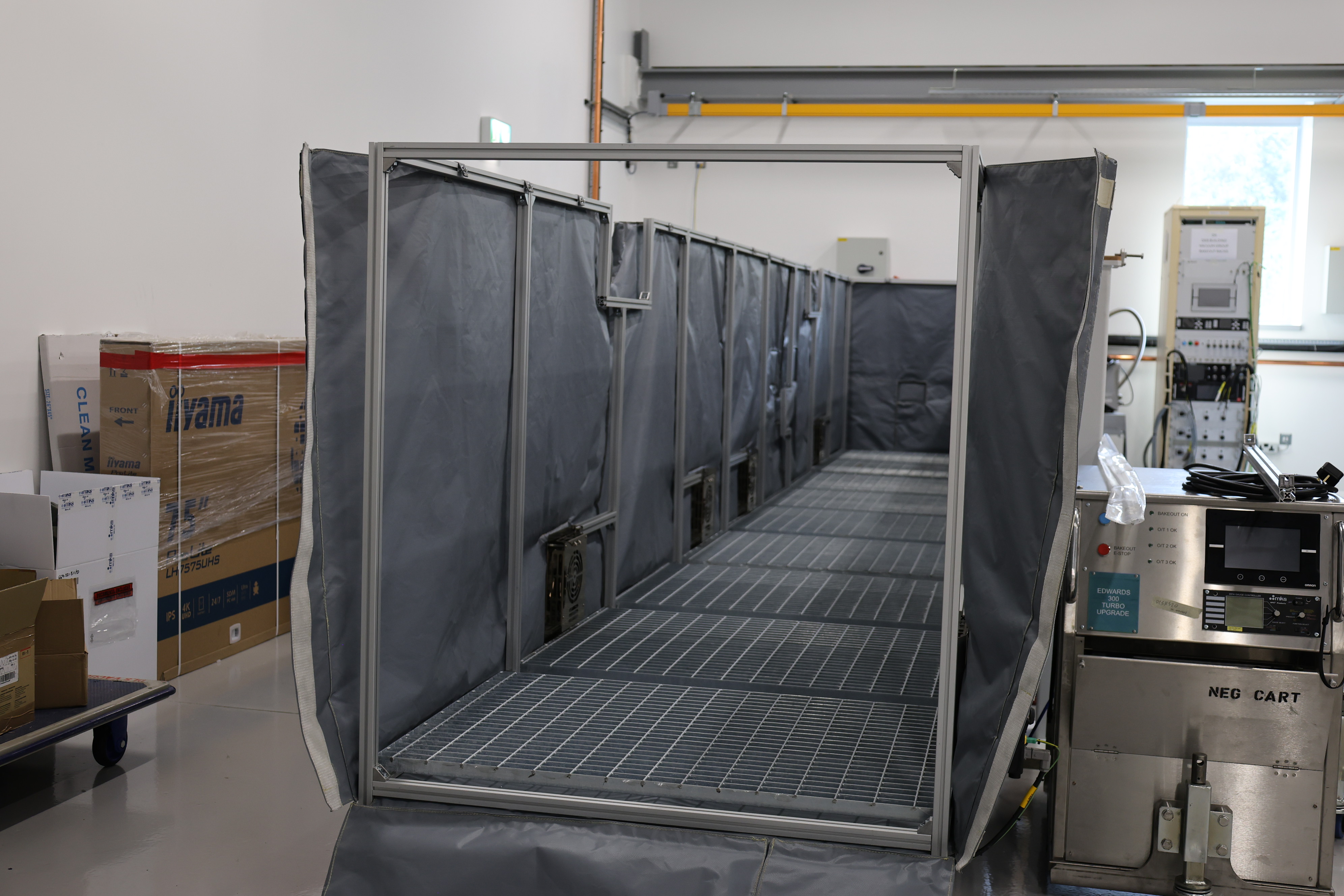
The assembled pre-series vacuum strings will now undergo a bakeout process in one of the DEB’s three 8-metre-long ovens. This process serves a dual purpose - both to remove any surface contamination and to activate the NEG coating. Each entire vacuum string will be moved from its assembly location to the ovens using a lifting frame and crane system. This stage is important to check that both the equipment and assembly process work as intended. Handling the strings as fully integrated units also allows the teams to check transport fixtures and lifting arrangements to ensure they maintain alignment and rigidity throughout the process.
Following the bakeout, the strings will move into the girder assembly area of the DEB where teams will work to install them onto the pre-series girders and integrate them with the magnets, cabling and pipework. The pre-series programme provides an important opportunity to validate the design, equipment and assembly processes before full production begins for the Diamond-II storage ring upgrade.

Diamond Light Source is the UK's national synchrotron science facility, located at the Harwell Science and Innovation Campus in Oxfordshire.
Diamond Light Source Ltd
Diamond House
Harwell Science & Innovation Campus
Didcot
Oxfordshire
OX11 0DE
Copyright © Diamond Light Source. Diamond Light Source® and the Diamond logo are registered trademarks of Diamond Light Source Ltd
Registered in England and Wales at Diamond House, Harwell Science and Innovation Campus, Didcot, Oxfordshire, OX11 0DE, United Kingdom. Company number: 4375679. VAT number: 287 461 957. Economic Operators Registration and Identification (EORI) number: GB287461957003.