Piezoelectric materials
Oct 1, 2010
Oct 1, 2010
Scientists are using Diamond Light Source, the UK’s national synchrotron facility, to discover how we can detoxify our electronic gadgets. Results published in the journal Applied Physics Letters on 1st October reveal the potential for new artificial materials that could replace lead-based components in everyday products from inkjet printers to digital cameras.
"These results are very encouraging. Although harmless when in use, at the end of their lifetime these PZT gadgets have to be carefully disposed of due to their lead content and as a consequence, there is significant interest in developing lead-free ceramics."Dr Tim Comyn, University of Leeds
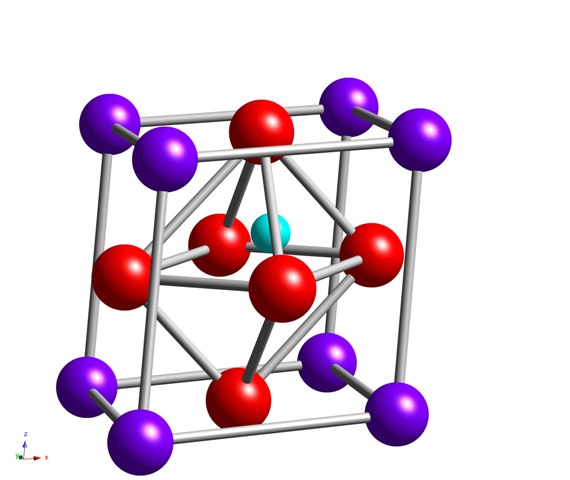
Crystal structure of KNBT before the application of an electric field (left) and after (right). The purple spheres are either sodium or potassium atoms, the red spheres are oxygen atoms, the small blue sphere is titanium. The figures show the arrangement of the atoms changing from rhombohedral, where the a, b and c axes are of the same length and rhombohedral angle is less than 90, to tetragonal symmetry, where the a and b axes are of the same length and the c axis is longer.
Piezoelectric materials generate an electrical field when pressure is applied, and vice versa. For example in gas igniters, like those used on ovens and fires, a piezoelectric crystal creates sparks when hit with the hammer. In an electrical field, it undergoes a phase transition, that is changes in the crystal structure.
The team will continue to work at Diamond to study the electric field induced transformation at high speed (1000 times per second) and under various conditions using state of the art detectors.
"Not only could a lead-free solution mean safer disposal of electronic equipment, by virtue of the absence of lead, these new materials are far lighter than PZT. The piezoelectric market has applications in many fields, where a lighter lead-free alternative could make quite a difference."Adam Royles, University of Leeds
In the medical field, PZT is used in ultrasound transducers, where it generates sound waves and sends the echoes to a computer to convert into a picture. Piezoelectric ceramics also hold great potential for efficient energy harvesting, a possible solution for a clean sustainable energy source in the future.
The global market for piezoelectric-operated actuators and motors was estimated to be $6.6 billion in 2009 and is estimated to reach $12.3 billion by 2014[1].
[1] Source: iRAP press release 19/07/10: Global market for piezoelectric-operated actuators and motors to reach $12.3 billion by 2014.
Electric-field-induced phase switching in the lead free piezoelectric potassium sodium bismuth titanate. A.J. Royles, A.J. Bell, A.P. Jephcoat, A.K. Kleppe, S.J. Milne and T.P. Comyn.
Applied Physics Letters. (Vol.97, Issue 13). DOI: 10.1063/1.3490235
Sarah Bucknall [email protected] T: 01235 778639; M: 07920 296957
Silvana Westbury [email protected] T: 01235 778238; M: 07841 432780
Paula Gould, University of Leeds press office [email protected] T: 0113 343 8059

Diamond Light Source is the UK's national synchrotron science facility, located at the Harwell Science and Innovation Campus in Oxfordshire.
Diamond Light Source Ltd
Diamond House
Harwell Science & Innovation Campus
Didcot
Oxfordshire
OX11 0DE
Copyright © Diamond Light Source. Diamond Light Source® and the Diamond logo are registered trademarks of Diamond Light Source Ltd
Registered in England and Wales at Diamond House, Harwell Science and Innovation Campus, Didcot, Oxfordshire, OX11 0DE, United Kingdom. Company number: 4375679. VAT number: 287 461 957. Economic Operators Registration and Identification (EORI) number: GB287461957003.