First users on I13
Nov 22, 2011
Nov 22, 2011
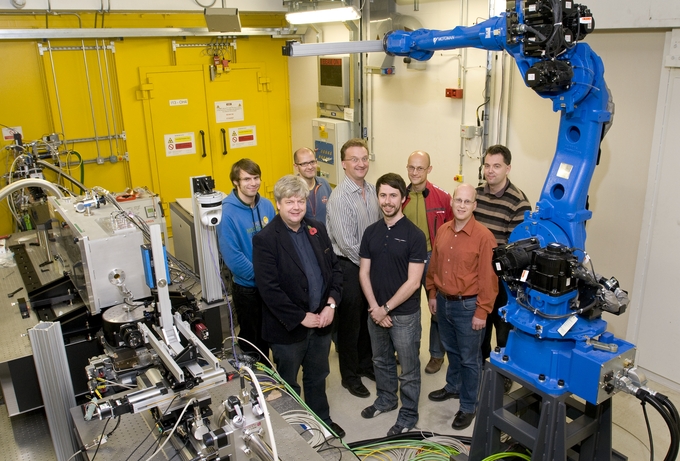
Diamond’s X-ray Imaging and Coherence beamline has welcomed its first users. Researchers from the Universities of Manchester and Sheffield worked with the beamline team to develop techniques on the coherence branch of I13.
Professor John Rodenburg from the University of Sheffield, one of the lead researchers on the project, said, “We were using a variety of samples as a means to test the beamline’s capabilities. My team and I are working on a pioneering technique called ptychography which involves exploiting the coherent light in such a way that we are able to combine diffraction and image data to create a high resolution computer-generated image of our sample, at the nanometre scale. It is a particularly useful technique for weakly diffracting and transparent samples. Since I13 is just starting out, we were working on the micron scale but we managed to get some useful data so we’re really pleased and look forward to making use of the beamline in the future to help develop our technique.”
Coherence is a property of light, when it is considered in its wave-form as opposed to as particles. Beamline I13 sits 250m away from its X-ray source in order to produce fully coherent light to enable a wide variety of experiments.
“We start with a very small light source at 15x200 microns, which we have achieved with the mini-beta set up within the storage ring, and we let that light travel a long distance so that it fans out into a large, lateral coherent light beam. Having a small electron beam at the source allows us to close the undulator gap to 6mm meaning we receive very brilliant light, which can be described to have laser-like qualities, inside the experimental hutch. Ultimately, we expect to get the spot size of the X-ray beam down to 15 nanometres, which will enable us to achieve top quality results of very high spatial resolution.”Principal Beamline Scientist, Professor Christoph Rau
Co-collaborator on the first experiment on the coherence branch and member of the I13 User Working Group, Dr Thomas Waigh from the University of Manchester, said, “It’s really exciting to achieve results from the coherence branch of I13. It has been ten years in the planning so to see it take shape and record some good data has been great. It is a unique instrument that promises to deliver a lot of important results, helping to solve real world problems in a wide range of fields. I am very pleased to be a part of its history.”

Diamond Light Source is the UK's national synchrotron science facility, located at the Harwell Science and Innovation Campus in Oxfordshire.
Diamond Light Source Ltd
Diamond House
Harwell Science & Innovation Campus
Didcot
Oxfordshire
OX11 0DE
Copyright © Diamond Light Source. Diamond Light Source® and the Diamond logo are registered trademarks of Diamond Light Source Ltd
Registered in England and Wales at Diamond House, Harwell Science and Innovation Campus, Didcot, Oxfordshire, OX11 0DE, United Kingdom. Company number: 4375679. VAT number: 287 461 957. Economic Operators Registration and Identification (EORI) number: GB287461957003.