Improved antihistamines
Jun 22, 2011
Jun 22, 2011
New 3D picture of human membrane protein enables development of targeted anti-histamines without side-effects.
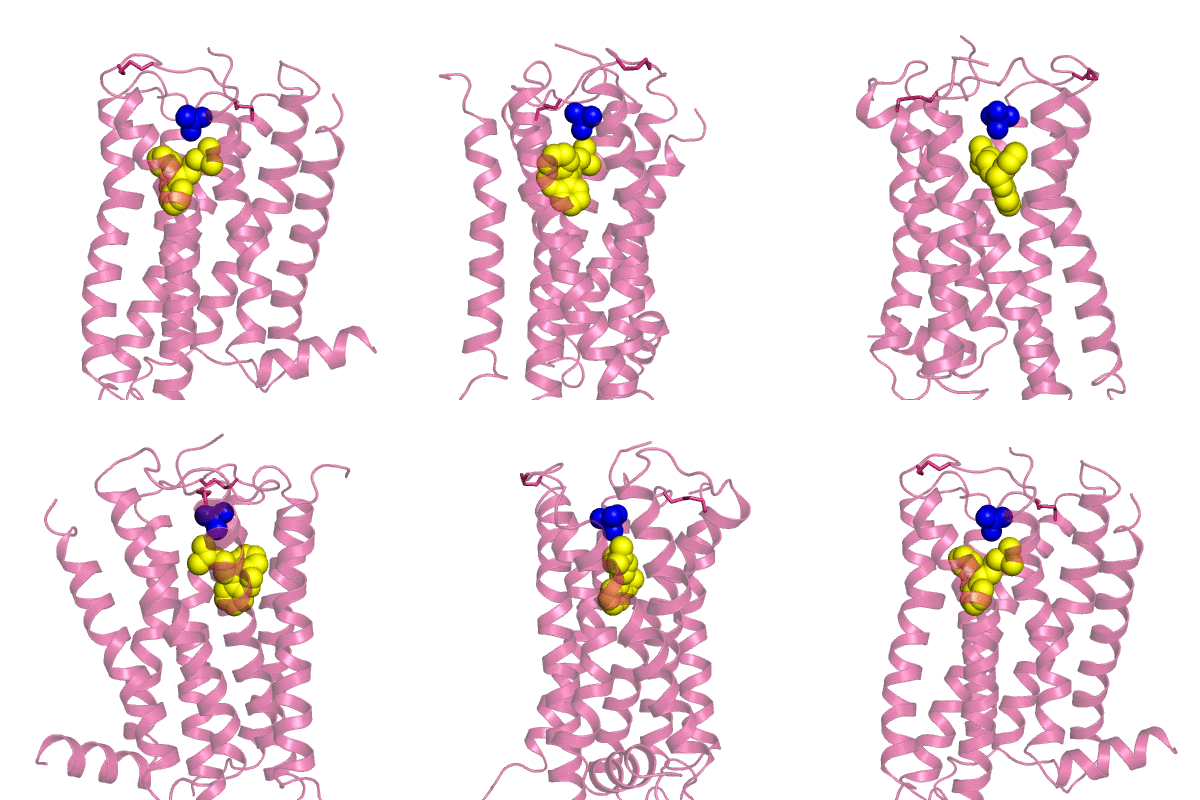 An international team of scientists using Diamond Light Source, the UK’s national synchrotron facility, has successfully solved the complex 3D structure of the human Histamine H1 receptor protein (pictured right). Published in the journal Nature this week, their discovery opens the way for the development of ‘third generation’ anti-histamines, specific drugs effective against various allergies without causing adverse side-effects.
The team, comprising leading experts from the USA (The Scripps Research Institute in California), Japan (Kyoto University), and the UK (Imperial College London and Diamond), worked across three continents for 16 months on the project.
“It took a considerable team effort but we were finally able to elucidate the molecular structure of the Histamine H1 receptor protein and also see how it interacts with anti-histamines. This detailed structural information is a great starting point for exploring exactly how histamine triggers allergic reactions and how drugs act to prevent this reaction.”Professor So Iwata, David Blow Chair of Biophysics at Imperial College London, BBSRC Fellow and Director of the Membrane Protein Laboratory at Diamond
H1 receptor protein is found in the cell membranes of various human tissues including airways, vascular and intestinal muscles, and the brain. It binds to histamine, an important function of the immune system, but in susceptible individuals this can cause allergic reactions such as hay fever, food and pet allergies. Anti-histamine drugs work because they prevent histamine attaching to H1 receptors.
“First generation anti-histamines such as Doxepin are effective, but not very selective, and because of penetration across the blood-brain barrier, they can cause side effects including sedation, dry mouth and arrhythmia. By showing exactly how anti-histamine drugs bind to the H1 receptor at the molecular level, we can design and develop much more targeted treatments.”Dr Simone Weyand, post-doctoral scientist at Imperial College London
The research was technically challenging because membrane proteins are notoriously difficult to crystallise – a step that is vital in solving protein structures using a synchrotron. The protein was produced in cells at Kyoto University in Japan, then processed cell material was flown to Professor Raymond Stevens at The Scripps Research Institute in La Jolla, California, who leads the GPCR Network of the National Institute of General Medical Sciences' Protein Structure Initiative, and has developed powerful techniques to analyse membrane proteins and crystallise G-protein coupled receptors (GPCRs) funded by the National Institutes of Health Common Fund.
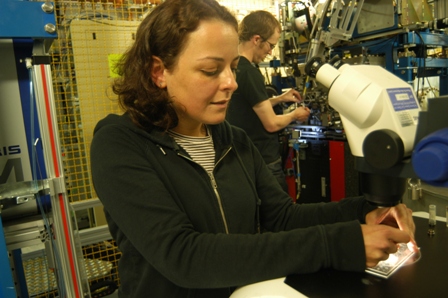 The crystals took around two months to grow and when each batch of around 100 was ready, they were frozen and flown to the UK. Here, Prof Iwata and Dr Weyand (pictured left on I24) worked with Diamond’s scientists to analyse a total of over 700 samples using the Microfocus Macromolecular Crystallography (MX) beamline I24, a unique instrument capable of studying tiny micro-crystals using an X-ray beam a few microns wide.
 Prof Iwata added: “The fact that we’ve managed to solve this structure in 16 months starting from pure protein is very exciting as it shows what can be achieved when a team of experts pool skills and experience in sample preparation, experimental techniques and data analysis. Having the Membrane Protein Laboratory situated inside the Diamond synchrotron itself is a major advantage for projects like this. We’ve benefited from rapid-access to the beamline and round the clock support for our experiments and data analysis work.”
Right: Prof So Iwata and Dr Simone Weyand working on the Microfocus Macromolecular Crystallography beamline at Diamond Light Source
“Solving this challenging structure so quickly is a significant achievement for Profs Iwata and Stevens, their groups and the I24 beamline team. I’m delighted that, in addition to providing access to cutting-edge research facilities, our scientists and technical experts have played an active role in this exciting project and I look forward to many future discoveries from the Membrane Protein Laboratory and the Microfocus MX beamline.”Professor Gerd Materlik, Diamond’s Chief Executive
- ENDS -
‘Structure of the human histamine H1 receptor complex with doxepin’
Tatsuro Shimamura, Mitsunori Shiroishi, Simone Weyand, Hirokazu Tsujimoto, Graeme Winter, Vsevolod Katritch, Ruben Abagyan, Vadim Cherezov, Wei Liu, GyeWon Han, Takuya Kobayashi, Raymond C. Stevens & So Iwata.
Nature, 22 June 2011
http://dx.doi.org/10.1038/nature10236

Diamond Light Source is the UK's national synchrotron science facility, located at the Harwell Science and Innovation Campus in Oxfordshire.
Diamond Light Source Ltd
Diamond House
Harwell Science & Innovation Campus
Didcot
Oxfordshire
OX11 0DE
Copyright © Diamond Light Source. Diamond Light Source® and the Diamond logo are registered trademarks of Diamond Light Source Ltd
Registered in England and Wales at Diamond House, Harwell Science and Innovation Campus, Didcot, Oxfordshire, OX11 0DE, United Kingdom. Company number: 4375679. VAT number: 287 461 957. Economic Operators Registration and Identification (EORI) number: GB287461957003.