Work begins on beamline I13
Jul 14, 2009
Jul 14, 2009
On Friday 26th June, the first turf was cut to make way for the latest experimental station to be added to the
The X-ray Imaging and Coherence beamline (I13), as it is known, will enable researchers from a wide range of scientific fields to create 3D images of all manner of material and biological samples. One exciting research area is a project involving studies on the cochlea (the inner ear), which are aimed at developing a deeper understanding of how hearing works.
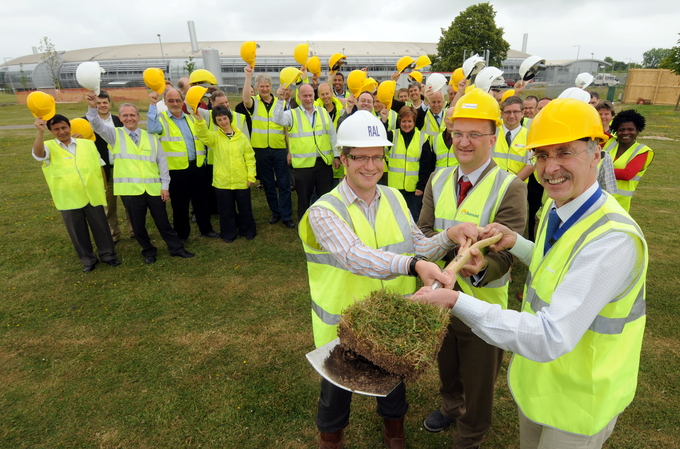 Designed for a broad range of scientific users from biomedicine, materials science, geophysics, astrophysics and archaeology fields, Diamond’s latest beamline will provide a tool for non-destructive examination of internal features at the micro (a few thousandths of a millimetre) and nano (a few millionths of a millimetre) length scale.
"After going through the comprehensive design process, bringing a wide and diverse user community on board, it is gratifying to be standing here today, starting the build on this interesting new beamline. I am looking forward to being able to welcome our first users in two years’ time and making a start on the exciting science it will be capable of."Prof. Christoph Rau, Principal Beamline Scientist for I13
I13 is the longest synchrotron experimental station in the western hemisphere, surpassed only by Spring 8 in Japan, where there is a beamline four times its length. Stretching 250m away from the iconic doughnut-shaped building, I13 is a break from the norm compared to Diamond’s other beamlines, most of which reside within the main building. The extended length of the beamline allows a special type of experiment called coherent imaging. Since the X-ray source is so far away from the sample, the X-rays fan out as they travel 250m down the beamline before illuminating the sample and effectively creating a minutely detailed holographic image down to the precision of a few microns to a few nanometres.
This technique is particularly useful for investigating structures which do not readily absorb X-rays such as soft tissue. For example, coherent imaging on I13 will enable researchers to study the membranes and cells in the cochlea, helping to better understand the hearing process under real conditions.
“Projects at the cutting edge of science, like Diamond, are pretty rare, so although this is a technically complex build, it is exciting to be involved in such an innovative building. At a time where much of the construction industry has been hit hard by recession, projects like this are very positive news and ensure Kier Moss can continue to bolster the local economy through using local suppliers and subcontractors who will in turn expand their building capacity and skills base.”Glyn Salmon, Director of Kier Moss, building contractor for I13
I13 is part of the second phase of construction at Diamond which is due to be complete by 2012. There are currently 13 beamlines up and running at the facility, with five more set to come online before the end of this year; including Diamond’s first experimental station to use infrared light (B22), and the Joint Engineering, Environmental and Processing (JEEP) beamline, which will be capable of examining components weighing up to two tonnes and up to the scale of one metre, promising to have a significant impact on the engineering industry.
For more information on Diamond’s X-ray Imaging and Coherence beamline, you can visit www.diamond.ac.uk/I13

Diamond Light Source is the UK's national synchrotron science facility, located at the Harwell Science and Innovation Campus in Oxfordshire.
Diamond Light Source Ltd
Diamond House
Harwell Science & Innovation Campus
Didcot
Oxfordshire
OX11 0DE
Copyright © Diamond Light Source. Diamond Light Source® and the Diamond logo are registered trademarks of Diamond Light Source Ltd
Registered in England and Wales at Diamond House, Harwell Science and Innovation Campus, Didcot, Oxfordshire, OX11 0DE, United Kingdom. Company number: 4375679. VAT number: 287 461 957. Economic Operators Registration and Identification (EORI) number: GB287461957003.